In the later nineteenth century, when the Canadian Impressionist Helen McNicoll (1879–1915) began her painting career, women artists in Europe and North America initiated a dramatic and sustained fight for access to education and exhibition opportunities on the same level as their male peers. Although women students continued to be barred from entry to the École des Beaux-Arts in Paris until 1897, a number of competing art schools emerged to cater to serious female students; first among them was the Slade School of Fine Art in London, which McNicoll attended from 1902 to 1904.
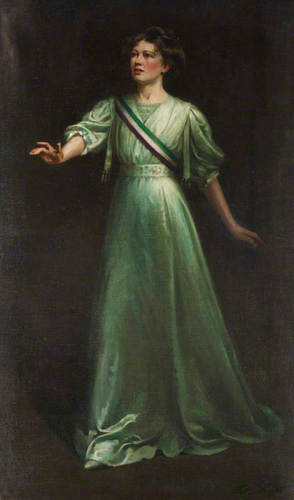
Ethel Wright, Dame Christabel Pankhurst, 1909
Oil on canvas, 160 x 94 cm, National Portrait Gallery, London
Pankhurst was a key figure in the suffrage movement in the years just before the First World War.
In response to their exclusion from art schools and professional societies, women created their own opportunities. McNicoll was a member of the Society of Women Artists (SWA) in London, and her partner, Dorothea Sharp (1874–1955), served as its vice-president. Originally established in 1856 as the Society of Female Artists, it sought to gain access for women to the male-dominated art world. McNicoll’s letters reveal why she found membership in a women’s-only society appealing. Following her election as an associate member of the Royal Society of British Artists (RBA) in 1913, she describes one experience at a “stormy meeting” when British artist and suffrage activist Ethel Wright (1866–1939) complained about the way her paintings had been hung in an exhibition:
She and Dolly [Dorothea Sharp] and I were the only women there . . . [and she] protested [that] the hangers were “ratters” and the hanging was a disgrace. You never saw so many angry and helpless looking men—when one who tried hard to keep her out of the society, moved that if she did not apologize she should resign. And she did resign, then and there. It was too bad because although her work was rather extreme it was interesting and helped to brighten the show.
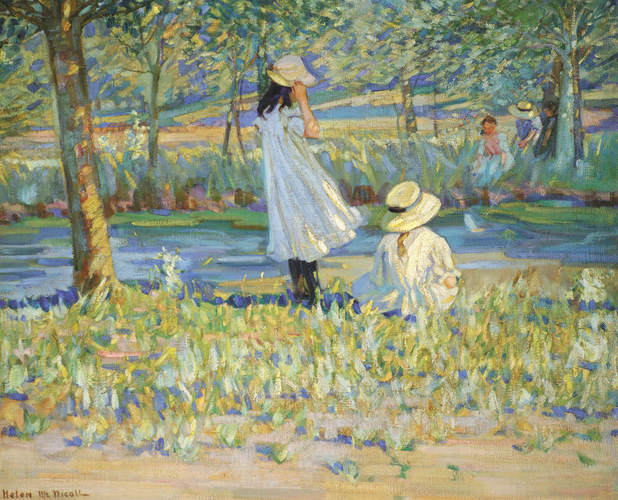
Helen McNicoll, Watching the Boat, c.1912
Oil on canvas, 64.1 x 76.8 cm, private collection, Vancouver
As women, McNicoll, Sharp, and Wright were acutely aware of their precarious position in the association. Alternatives like the SWA provided a strong network of patronage and professional support when traditional institutions failed to do so; in Canada, the Women’s Art Association served this need after 1890. At the Art Association of Montreal (AAM), the Women’s Art Society promoted the work of women artists like McNicoll, who won their prize for Under the Shadow of the Tent in 1914.
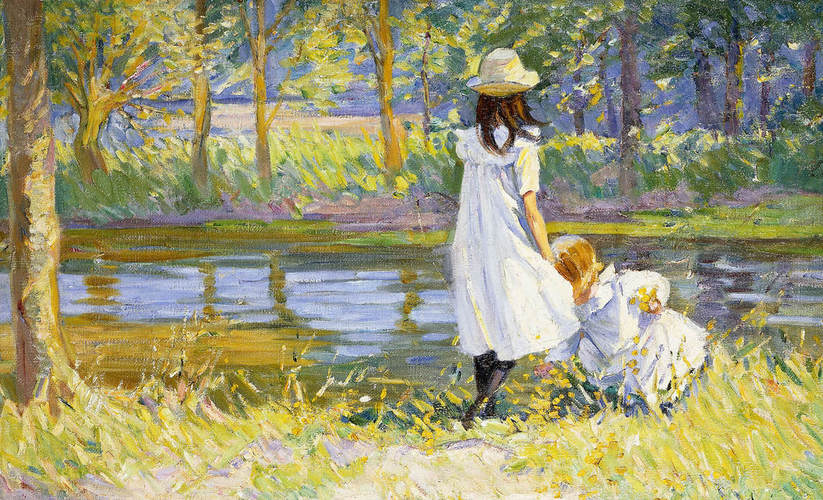
Dorothea Sharp, Two Girls by a Lake, c.1912
Oil on canvas, 47 x 76 cm, private collection
Informal personal relationships also helped to bolster a woman artist’s professional career. McNicoll’s close relationship with Sharp would have been especially important for success in a new country. Together, they shared the costs of studio space, supported one another during their travels, and give immediate feedback while they painted. The pair frequently painted similar subjects, as seen in McNicoll’s Watching the Boat and Sharp’s Two Girls by a Lake, both c.1912.
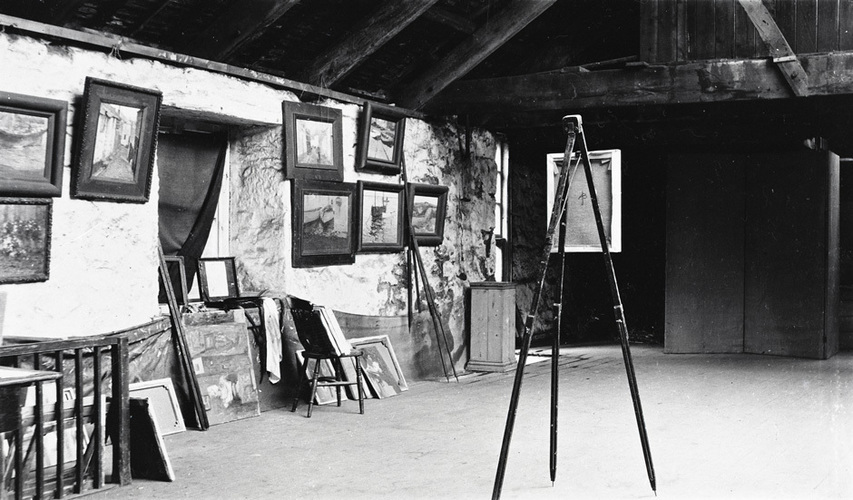
Helen McNicoll’s studio in St. Ives, Cornwall, c.1906
Photographer unknown, Helen McNicoll artist file, The Robert McLaughlin Gallery, Oshawa
McNicoll rented a studio in a converted fisherman’s loft in St. Ives, where she met Dorothea Sharp.
McNicoll faced hearing loss as the result of a childhood case of scarlet fever, and Sharp must also have provided important help in navigating the more practical parts of artmaking: hiring models, renting lodgings, and purchasing supplies. It also appears that Sharp played a key role in encouraging McNicoll to exhibit her work publicly in Montreal and London and to join formal professional associations. Letters show that Sharp advocated strongly for McNicoll before her election to the RBA. “Dolly worked very hard,” McNicoll wrote to her father. “She went around amongst the members and brought them up to my pictures[;] if they didn’t like them, she went after others.” In return, McNicoll opened doors in Canada for Sharp, who exhibited at the AAM on at least one occasion.
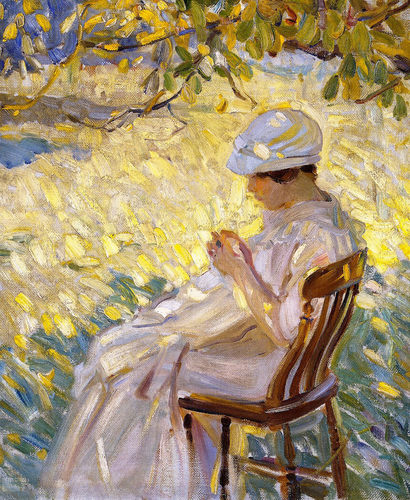
Helen McNicoll, Beneath the Trees, c.1910
Oil on canvas, 60 x 49.5 cm, McMichael Canadian Art Collection, Kleinburg
Despite McNicoll’s professional success during her lifetime, when histories of Canadian art began to be written in the 1920s, she was omitted, as were most of her female colleagues. In a new nationalist narrative, wild, open landscapes were given precedence over quiet domestic scenes such as McNicoll’s Beneath the Trees, c.1910. Not until the late twentieth century did McNicoll and her peers begin to see some recognition as practising professionals, largely due to the efforts of feminist art historians and curators who have attempted to recuperate their work. Still, research on Canadian women artists in the years before the First World War continues to lag far behind that on their female peers in France, England, and the United States.
This Essay is excerpted from Helen McNicoll Life & Work by Samantha Burton.
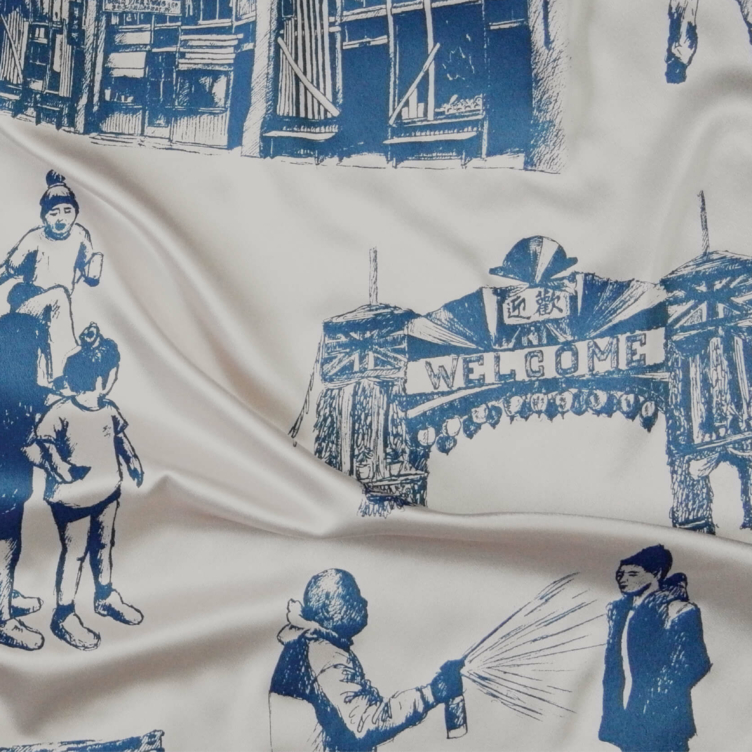 Karen Tam’s Autumn Tigers
Bridging Past and Present: Invisible Made Visible
By Imogene L. Lim, PhD
Karen Tam’s Autumn Tigers
Bridging Past and Present: Invisible Made Visible
By Imogene L. Lim, PhD
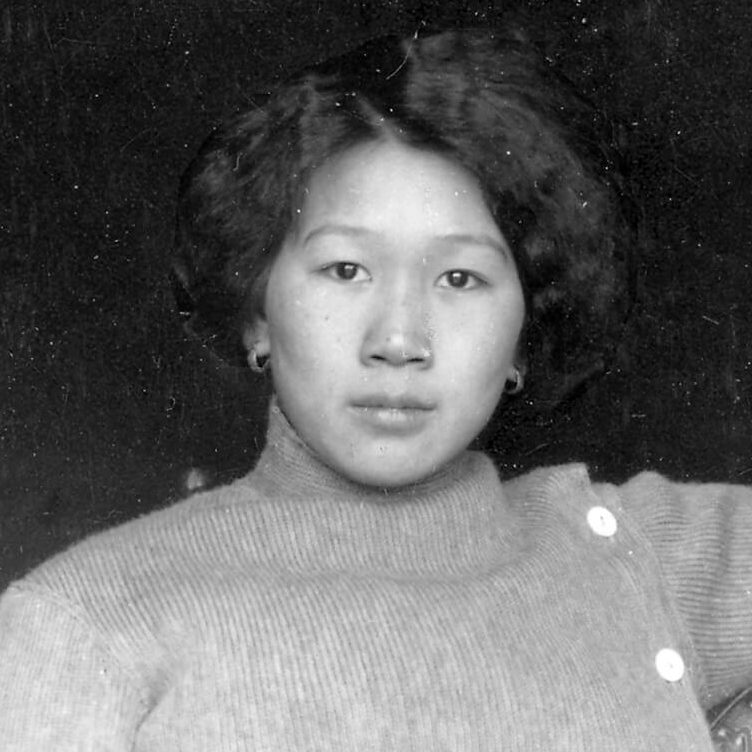 The Frontier Portraits of C.D. Hoy
A Chinese Canadian Photographer’s Tribute to His Community
By Faith Moosang
The Frontier Portraits of C.D. Hoy
A Chinese Canadian Photographer’s Tribute to His Community
By Faith Moosang
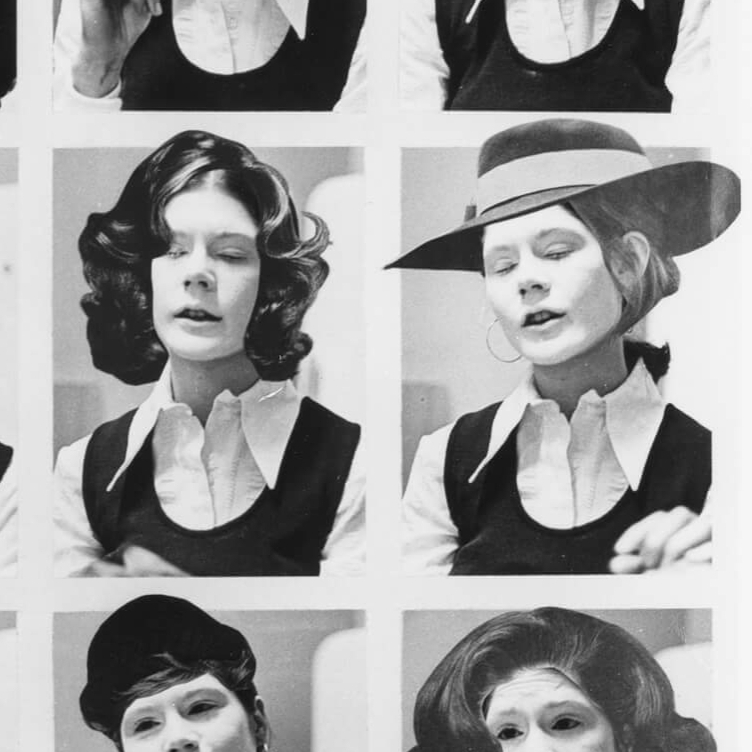 Interrogating Identity
Suzy Lake explores the role of photography in shaping how we understand and see ourselves
By Erin Silver
Interrogating Identity
Suzy Lake explores the role of photography in shaping how we understand and see ourselves
By Erin Silver
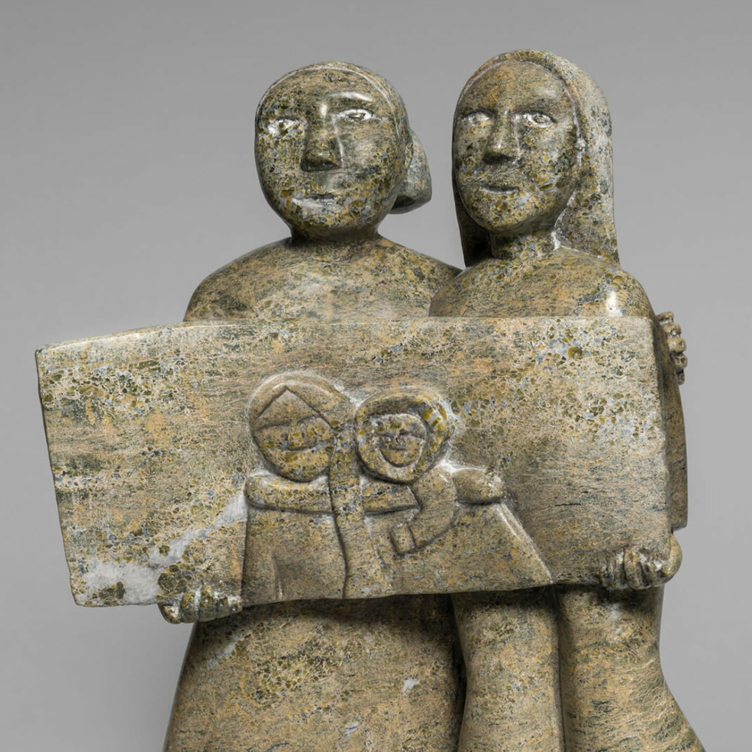 An Emboldened Artist
How Oviloo Tunnillie achieved rare international acclaim as an Inuit female sculptor
By Darlene Coward Wight
An Emboldened Artist
How Oviloo Tunnillie achieved rare international acclaim as an Inuit female sculptor
By Darlene Coward Wight
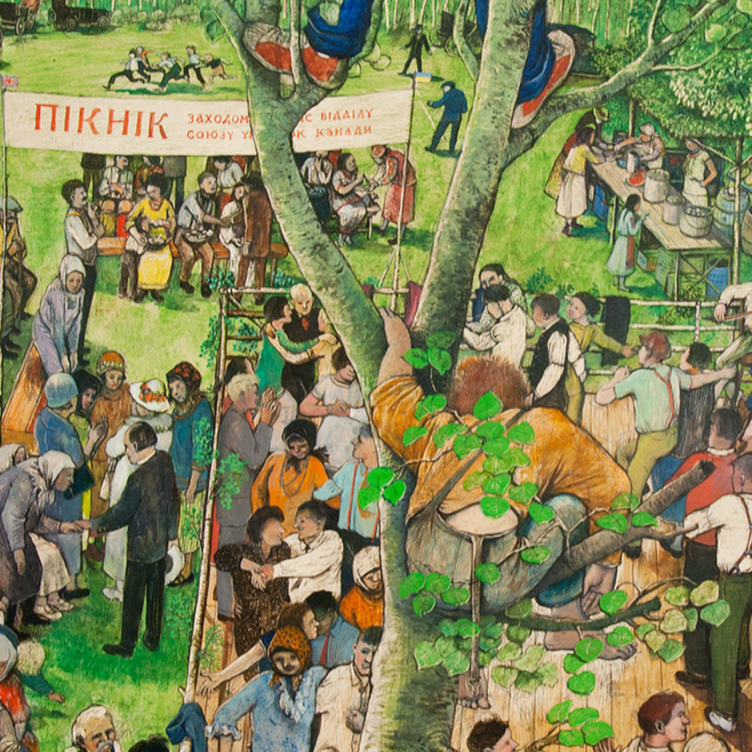 Painting the Cultural Mosaic
William Kurelek traversed the country in a quest to capture its diverse inhabitants
By Andrew Kear
Painting the Cultural Mosaic
William Kurelek traversed the country in a quest to capture its diverse inhabitants
By Andrew Kear
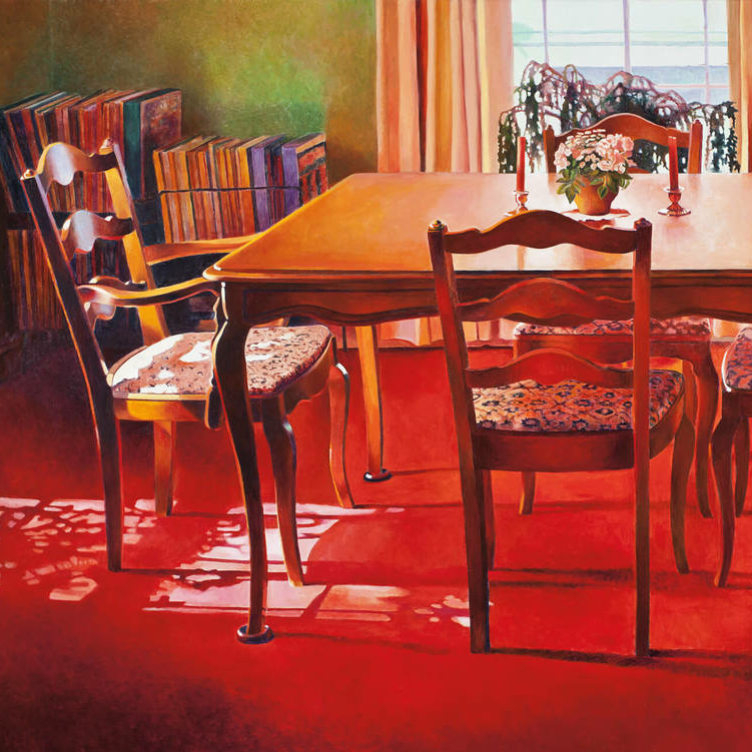 Domestic Discontent
Mary Pratt’s poetic scenes of home life are praised for their political edge
By Ray Cronin
Domestic Discontent
Mary Pratt’s poetic scenes of home life are praised for their political edge
By Ray Cronin
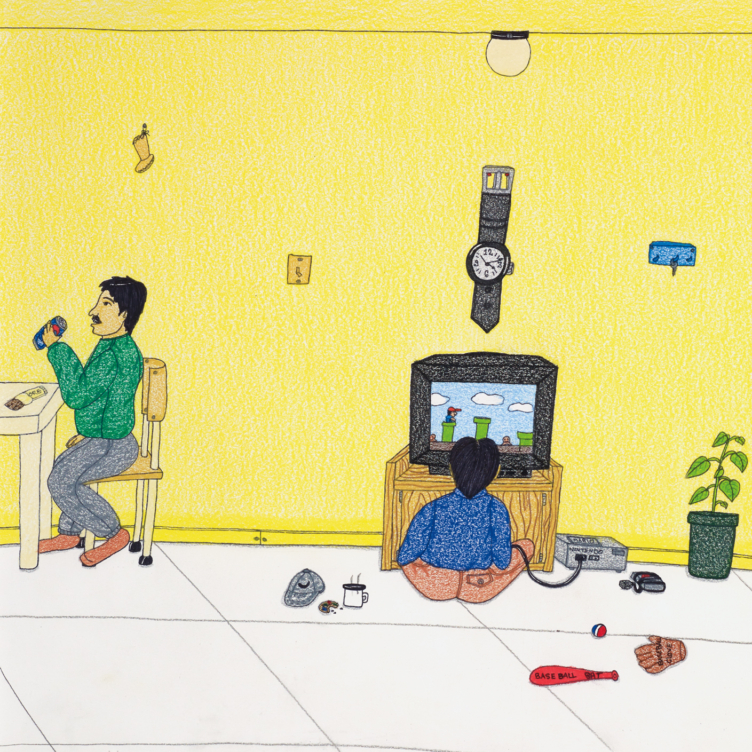 A New Vision of the North
Annie Pootoogook’s art offers unprecedented insights into the contemporary Arctic
By Nancy G. Campbell
A New Vision of the North
Annie Pootoogook’s art offers unprecedented insights into the contemporary Arctic
By Nancy G. Campbell
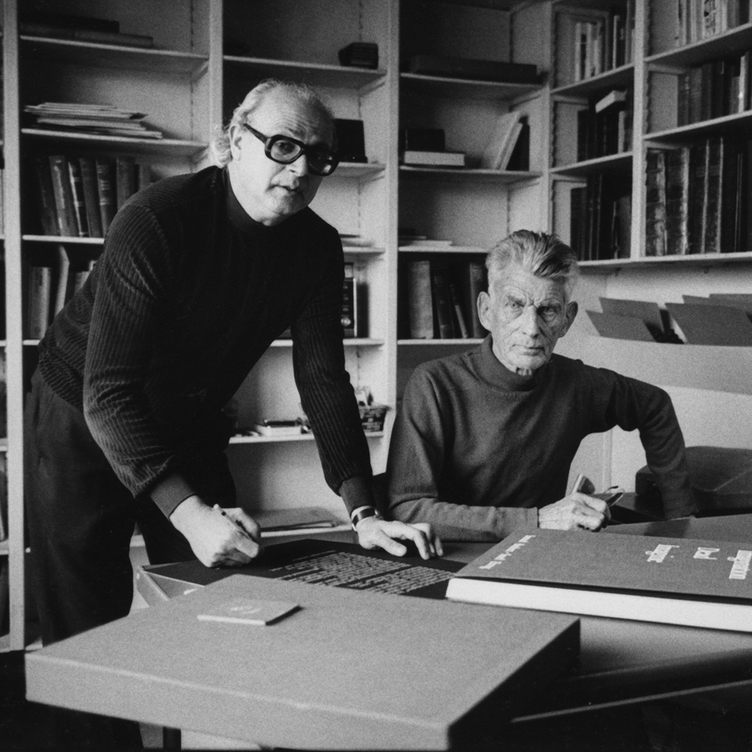 Meetings of Minds
Sorel Etrog found new ideas in collaborative work
By Alma Mikulinsky
Meetings of Minds
Sorel Etrog found new ideas in collaborative work
By Alma Mikulinsky
 Introducing Miss Chief
An excerpt from the ACI’s book “Revision and Resistance”
By Shirley Madill
Introducing Miss Chief
An excerpt from the ACI’s book “Revision and Resistance”
By Shirley Madill
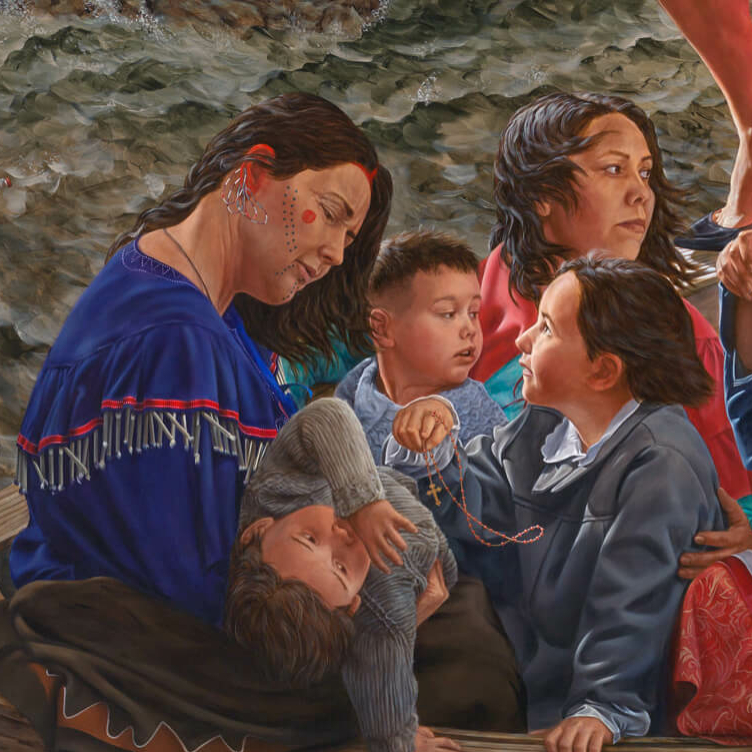 A Practice of Recovery
An excerpt from the ACI’s book “Revision and Resistance”
By Sasha Suda
A Practice of Recovery
An excerpt from the ACI’s book “Revision and Resistance”
By Sasha Suda
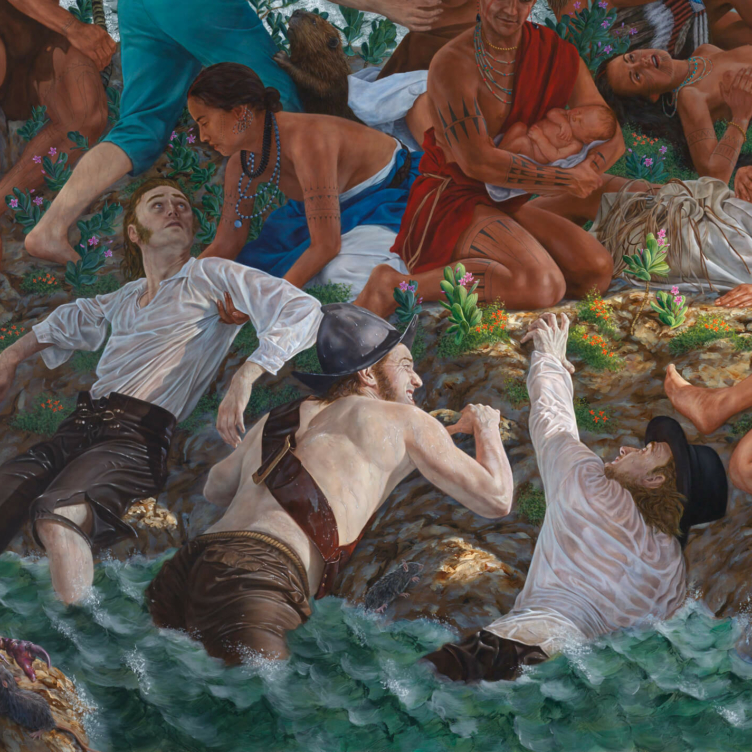 Decolonizing History Painting
An excerpt from the ACI’s book “Revision and Resistance”
By Ruth B. Phillips and Mark Salber Phillips
Decolonizing History Painting
An excerpt from the ACI’s book “Revision and Resistance”
By Ruth B. Phillips and Mark Salber Phillips
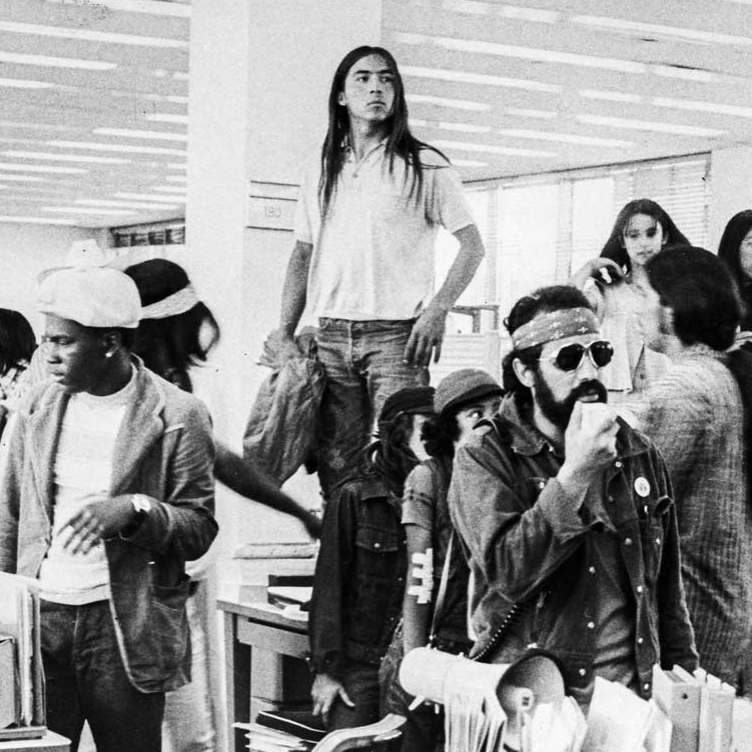 A Vision for the Future
An excerpt from the ACI’s book “Revision and Resistance”
By Nick Estes
A Vision for the Future
An excerpt from the ACI’s book “Revision and Resistance”
By Nick Estes
 Inside Kent Monkman’s Studio
An excerpt from the ACI’s book “Revision and Resistance”
By Jami C. Powell
Inside Kent Monkman’s Studio
An excerpt from the ACI’s book “Revision and Resistance”
By Jami C. Powell
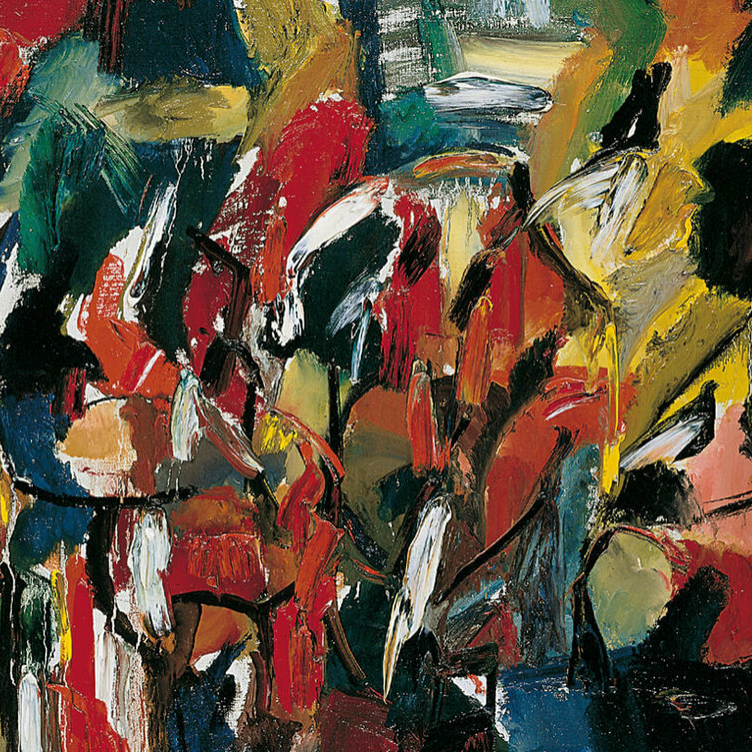 The Rule of Chance
Jean Paul Riopelle’s break with Automatism
By François-Marc Gagnon
The Rule of Chance
Jean Paul Riopelle’s break with Automatism
By François-Marc Gagnon
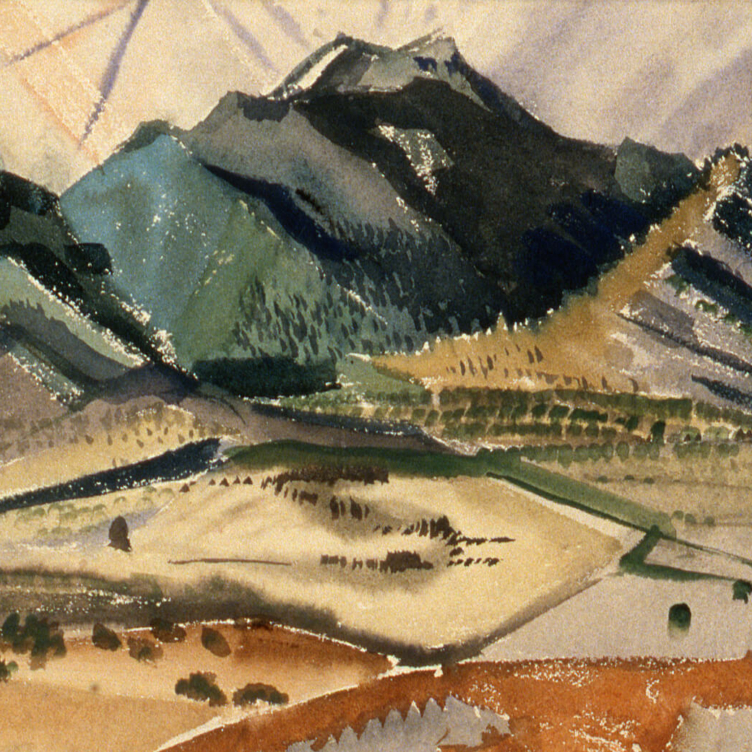 From Taos to New York
Agnes Martin and the currents of American Art
By Christopher Régimbal
From Taos to New York
Agnes Martin and the currents of American Art
By Christopher Régimbal
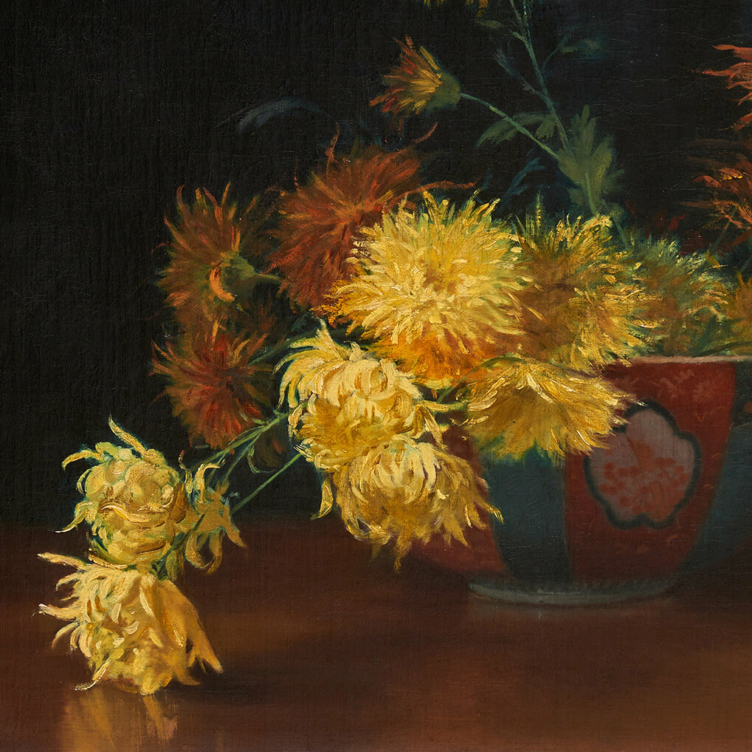 An Artist Blooms
Mary Hiester Reid’s floral aesthetics
By Andrea Terry
An Artist Blooms
Mary Hiester Reid’s floral aesthetics
By Andrea Terry
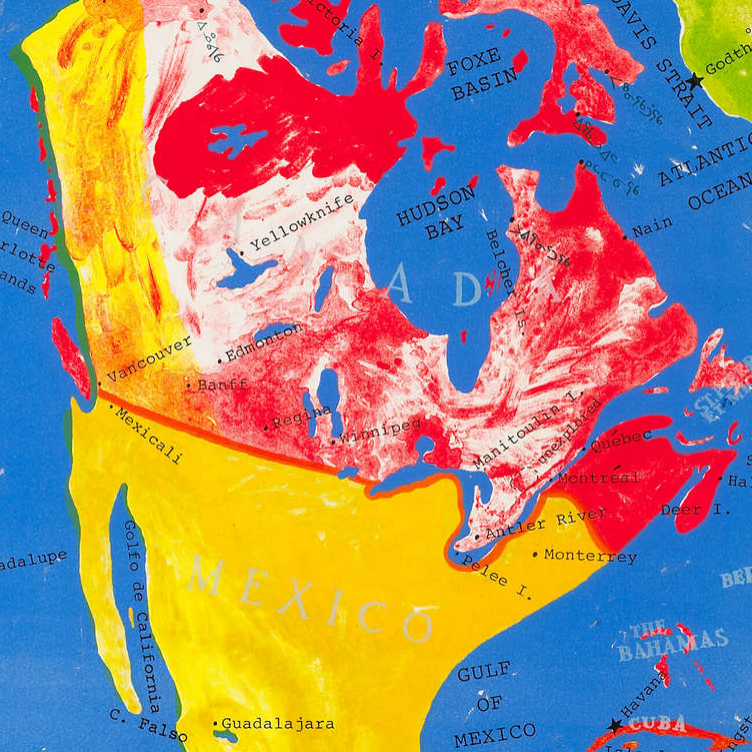 The Patriotic Painter
Greg Curnoe’s Canada
By Judith Rodger
The Patriotic Painter
Greg Curnoe’s Canada
By Judith Rodger
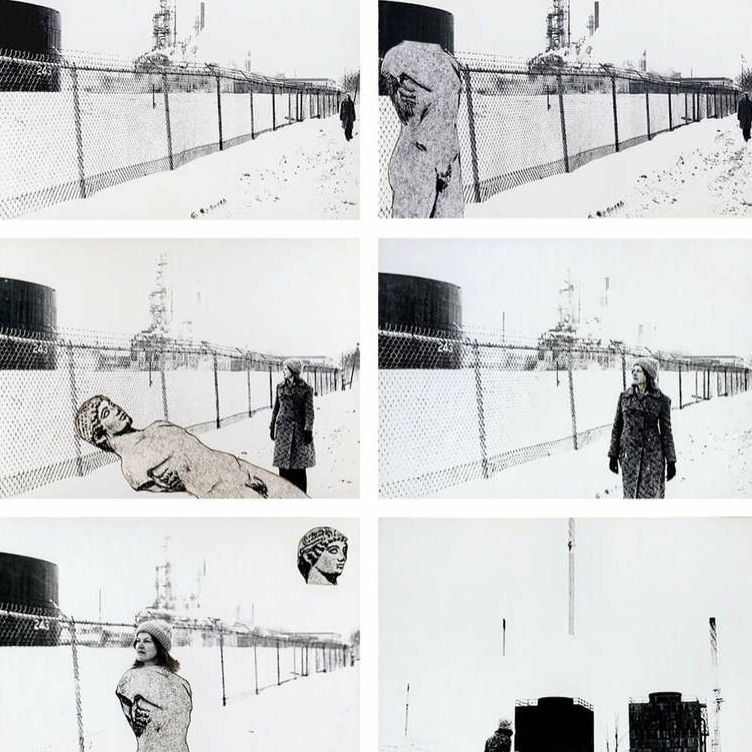 Walking, Stacking, Dancing
Françoise Sullivan’s conceptual 1970s
By Annie Gérin
Walking, Stacking, Dancing
Françoise Sullivan’s conceptual 1970s
By Annie Gérin
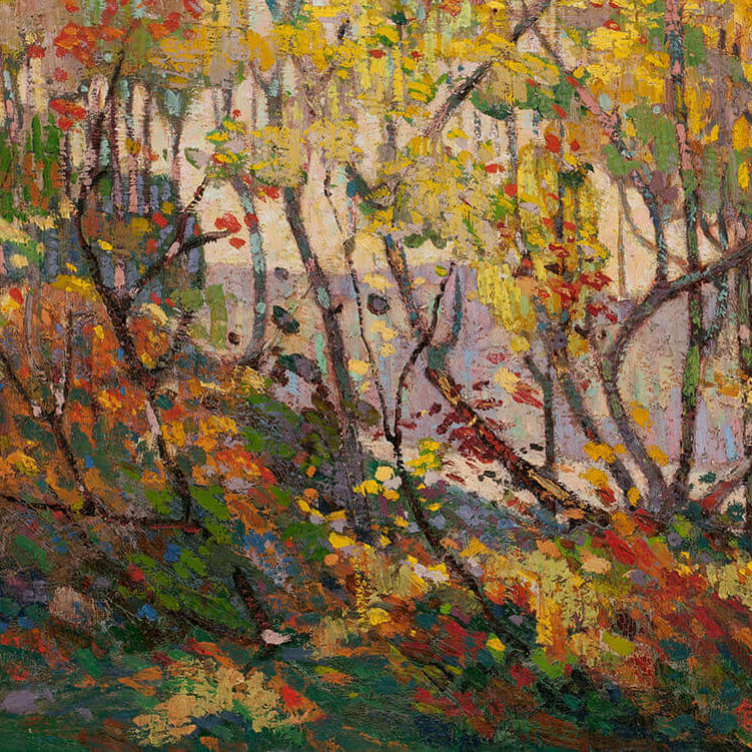 The Extraordinary North
Tom Thomson’s diary of landscape
By David P. Silcox
The Extraordinary North
Tom Thomson’s diary of landscape
By David P. Silcox
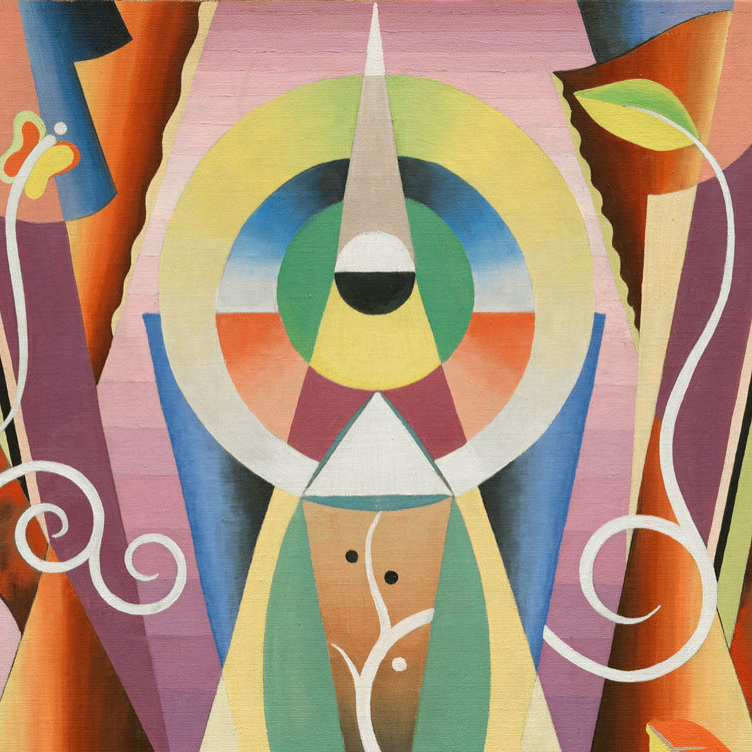 A Champion of Abstraction
Jock Macdonald sought a new expression in art
By Joyce Zemans
A Champion of Abstraction
Jock Macdonald sought a new expression in art
By Joyce Zemans