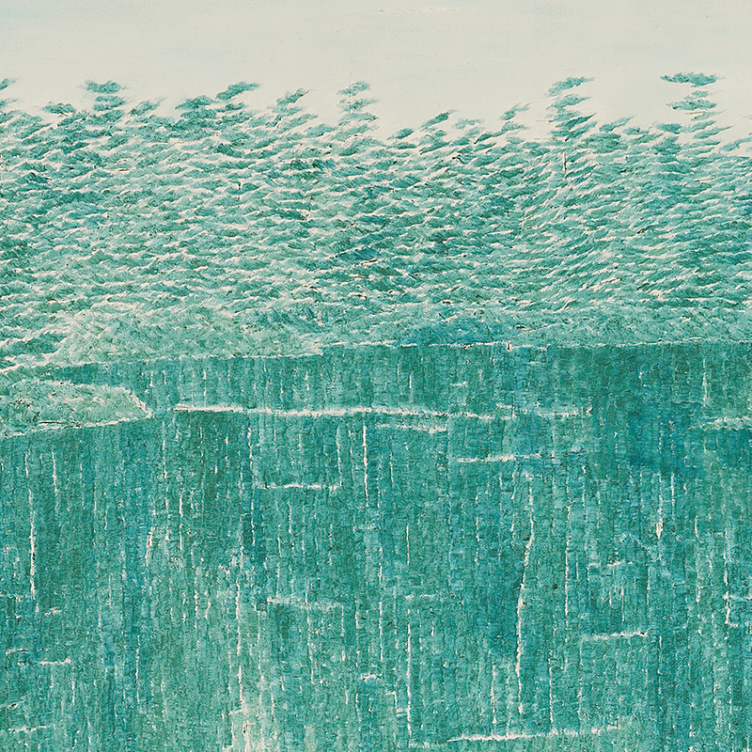
In 1967 the Polish-born artist and Holocaust survivor Gershon Iskowitz (1919–1988) created a series of paintings; his first compositions with ovoid forms floating on a neutral background. Each one was titled Landscape, preceded by spring, summer, or autumn. The largest group, called Autumn Landscape, had eight numbered variations. Iskowitz’s use of “landscape” in the title reinforced the interpretation that his work was derived from nature—he even referred to leaves when speaking of the 1967 works. Yet he rarely offered details about his inspirations and process beyond a few repeated poetic and idyllic responses to interviewers’ questions. He expected the compositions to speak for themselves. In all likelihood, Iskowitz applied the titles rather than “painting to them.”
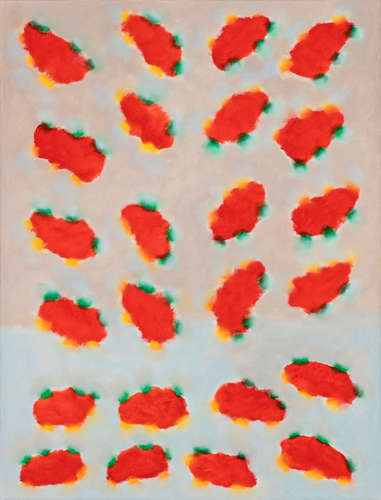
Oil on canvas, 129.5 x 99.1 cm, Art Gallery of York University, Toronto
Of his 1967 works, Iskowitz said “everything was falling down. The leaves were falling down.” If so, he represented them in flight, not on the ground. Alternatively, the ovoids may represent cloud formations that are not “cloud-coloured.” As Theodore Heinrich writes, “[Iskowitz] not only completely abandoned representation [but] altered his position with relation to it.” And, he continues: “This might be termed intimate cartography, poeticized by its sensibility to season change and the times of day or night, clear or overcast as expressed by light.”
This Spotlight is excerpted from Gershon Iskowitz: Life & Work by Ihor Holubizky.
 Stitching the Archives
 A Working-Class Hero
 Imagining Entangled Futures
 Bridging Far and Near
 Soft Power
 Imagining Emancipation
 A Priceless Portrait
 Meditation in Monochrome
 Making His Mark
 Honour and Sacrifice
 A Monstrous Vision
 Remote Beauty
 Pride and Resistance
 Dressed for Danger
 Masks from the Past
 Lessons from the Land
 A Cultural Hero
 Food for Thought
 A Passion for Activism
 Starvation and Scandal