Paterson Ewen (1925–2002) shied away from portraits, just as he shied away from people; they made him uncomfortable. Yet in 1989 Ewen stated: “People think of me as a landscape painter because I’ve done hundreds of landscape images, but my half dozen portraits are my greatest works.” Of them, Bandaged Man is probably the best known. Like the artist himself, this portrait is awkward, unnerving, and disturbingly captivating. Bandaged Man relates to Ewen finally being able to heal after a traumatic eight-year period that started with his leaving his first wife, Françoise Sullivan (b. 1923), in 1965.
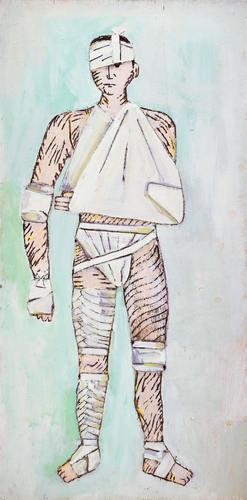
Paterson Ewen, The Bandaged Man, 1973
Acrylic and cloth on plywood, 243.8 x 121.9 cm, National Gallery of Canada, Ottawa
The work was inspired by an etching in an encyclopedia that accompanied an entry about different types of bandages. As Ewen explained:
I was a bit of a wreck at the time after my year in Toronto. And as I went along with the bandaged man I began to realize it looked more and more like me. It had my body and it became very scary. When I went to bed at night I used to turn it to the wall. There’s no question it is a kind of self-portrait. Maybe it’s going too far but I’m not so sure. To say maybe I did that at a time when I was a wreck and needed bandages.
The background colour is reminiscent of the standard light green walls of a hospital, a place he was all too familiar with.
This Spotlight is excerpted from Paterson Ewen: Life & Work by John G. Hatch.
 Stitching the Archives
 A Working-Class Hero
 Imagining Entangled Futures
 Bridging Far and Near
 Soft Power
 Imagining Emancipation
 A Priceless Portrait
 Meditation in Monochrome
 Making His Mark
 Honour and Sacrifice
 A Monstrous Vision
 Remote Beauty
 Pride and Resistance
 Dressed for Danger
 Masks from the Past
 Lessons from the Land
 A Cultural Hero
 Food for Thought
 A Passion for Activism
 Starvation and Scandal