Harold Town (1924–1990) showed Day Neon at the second Painters Eleven group exhibition, in 1955. In the work, Town allows forms to emerge through drawing, using a method similar to the Surrealist automatism practised by the Automatistes in Montreal in the 1940s, and by New York painters Arshile Gorky (1904–1948), Jackson Pollock (1912–1956), and Willem de Kooning (1904–1997). But the colliding diagonals and sense of continuous movement also recall the visual language of the action comics featuring Captain Marvel and Minute-Man that Town loved during boyhood.
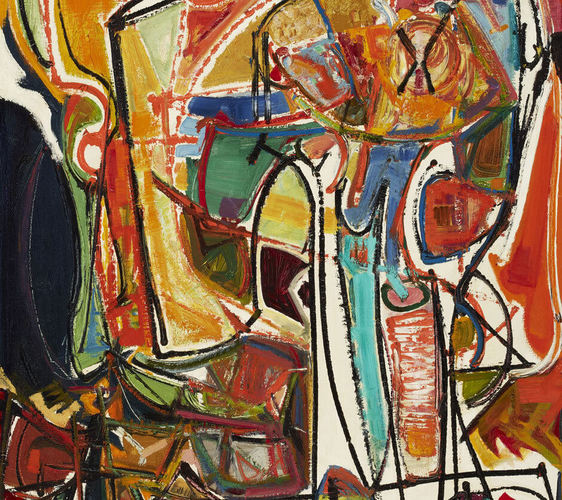
Harold Town, Day Neon (detail), 1953
Oil on Masonite, 91.1 x 63.5 cm, Robert McLaughlin Gallery, Oshawa
The painting’s title points to an urban scene; the neon lights of Toronto’s developing streetscape are a frequent theme in Town’s work at this time. He believed that great formal art could be inspired by the modern city: “I suddenly realized these signs were beautiful, all those gorgeous blues, and I realized that if an Egyptian from the time of one of the great Pharaohs were to walk down the street he would have found them a mystery, an overwhelming mystery. There’s everything there.”
This Spotlight is excerpted from Harold Town Life & Work by Gerta Moray.
 Stitching the Archives
 A Working-Class Hero
 Imagining Entangled Futures
 Bridging Far and Near
 Soft Power
 Imagining Emancipation
 A Priceless Portrait
 Meditation in Monochrome
 Making His Mark
 Honour and Sacrifice
 A Monstrous Vision
 Remote Beauty
 Pride and Resistance
 Dressed for Danger
 Masks from the Past
 Lessons from the Land
 A Cultural Hero
 Food for Thought
 A Passion for Activism
 Starvation and Scandal